
Research has consistently shown that performance is improved after a taper ( in the order of 2-10%) .
The mechanisms for this improvement in performance can be neatly summarised by Wang et all in their study “ Effects of tapering on performance in endurance athletes: A systematic review and meta-analysis”
In endurance athletes, the primary mechanism for tapering to improve endurance sports performance is to maintain or further increase aerobic exercise capacity while eliminating the psychological and physiological stress accumulated from training
For example,
cardiac pump function and work efficiency improved
blood testosterone and blood testosterone/cortisol ratio improved significantly, whereas blood creatine kinase concentration and cortisol concentration decreased significantly
heart rate to rating of perceived exertion (RPE) ratio decreased
and emotional state improved.
In addition, studies have shown that tapering in endurance athletes significantly increases blood volume, hemoglobin, and erythrocyte pressure volume, and improves mitochondrial respiratory function.
The improvement of these indicators enables the improvement of the oxygen-carrying and oxygen-transport capacity, maintaining a higher percentage of oxygen utilization capacity, which ultimately leads to an increase in endurance performance.
Something to keep in mind is that the taper is not the time to be improving fitness, it is the time for the body to adapt to the training that has already been done.
Inigo stated in his “ Scientific Bases for Precompetition Tapering Strategies”
“… by the time they start tapering, athletes should have achieved most or all of the expected physiological adaptations, eliciting improved performance levels as soon as accumulated fatigue fades away and performance-enhancing adaptations become apparent.”
The generally accepted version of a taper is a 40-60% reduction over a 14-21 day period, maintaining intensity and frequency but reducing volume.
However, this conflicts with the practice of many elite athletes whose taper is often more in the 7-10 days range.
There is also evidence that a short period of pre-taper overload improved performance compared to a conventional taper.
Most studies on tapering have not been conducted on ultra-runners, so whether it holds true in ultras is uncertain.
So, how do we approach the taper for our athletes?
There are a few key principles to understand first.
1. The greater the fatigue levels, the greater the taper needed.
2. The more important the race the more important the taper is.
3. A taper is both physical and mental.
Let’s discuss these in detail.
1. Fatigue levels and the taper.
For many athletes, as they near the end of their peak training phase, fatigue is mounting, and although they are still getting their sessions done, its taking longer to warm up each day, and they are not exactly jumping out of bed with a spring in their step. Whilst training is not feeling like a chore, its not likely sustainable at this level for too much longer, and they are starting to look forward to it easing off.
For this type of athlete, a longer taper is recommended, of the order of 14-28 days. ( We will talk about what that might look like shortly.)
For athletes who aren’t in the depths of fatigue a shorter taper would be recommended. For example, if your athlete had some interruptions in their peak training phase – maybe they had a few days off here and there for sickness or were busy at work, those small reductions in training may have been enough to bring their fatigue levels back to more sustainable levels. For this athlete, a shorter taper of 7-14 days is likely all that’s needed.
2. Race importance.
Often we rank races in terms of “A” races, “B” races and “C” races, with A being the highest priority and C being a local race for fun. ( And I talk in detail about this in the race selection video )
The usual thinking is that in A races we push really hard in giving it all we have, vs C races are more of a training race. In reality, though, most athletes find it hard to do anything other than give 100% when they have a number pinned on them. The difference between an A race and a C race is much more about the taper. With minimal taper, the fatigue in one’s legs makes it harder to push 100% vs feeling super fresh after a long taper.
An A race might have a 2-4 week taper, a B race 1-2 week taper and a C race a 3 day taper.
3. A taper is both physical and mental.
What the athlete believes is true affects their mindset, whether it’s true or not. This means we have to keep in mind our athlete’s mental state when we plan a taper. If the athlete is feeling tired and wants a longer taper, then the last thing you want them to do is go into the race mentally thinking their taper was too short. Midway through the race, their thoughts may turn to – “ I knew the taper was too short, that’s why my legs are feeling so fatigued “
It’s important to get you and your athlete on the same page on how you approach the taper. Physically, you may think they don’t need a long taper, but mentally, they may be close to burnout.
What does a taper look like ?
The research is pretty clear on the broad principles of a taper – ie reduce volume, keep intensity and frequency the same. This, of course, is not specific to ultra-running, so we have to be mindful that we may need to take a slightly different approach depending on the athlete. But for now lets look at a traditional 21 day taper
Volume
This should reduce by 40-60% over the 21 day taper
The volume reduction in runner usually doing 100km a week may look like this
Week 4 – 100km – normal training
Week 3 – 80km
Week 2 – 60km
Week 1 – 40km + race
However, many would find running 40km in the lead up to an ultra too much and reducing that to 20-30km or even less may be beneficial.
Keep in mind that some ultras may start on Sunday so the final week is a 7-day week, but many others may start on a Saturday, Friday or even Thursday. If you are using Monday to Sunday definition of a week, then if the race starts earlier in the week it’s likely you will need to err on the side of a lot less than 40km in the taper week.
Intensity
There is an abundance of research to suggest that maintaining intensity in a taper for marathon and shorter races is beneficial. Now, whilst an ultra is not a marathon, the benefits of keeping some intensity in the taper should also apply to an ultra. ( eg increased blood plasma volume, decreased cortisol ).
The trick is making sure we don’t do too much intensity or the wrong level of intensity. I have talked before about risk vs reward, and in the taper, we need to consider that very carefully, as the number one priority is to get to the start line uninjured.
There is some evidence that high intensity sessions ( ie well above anaerobic threshold ) done in a taper can improve performance. BUT, and this is a significant BUT, those studies looked at races shorter than a marathon.
Given most ultra athletes have probably been doing tempo and threshold work in their peak training phase, I see no benefits in changing that to intensities well above anaerobic threshold in the taper. The rewards for doing so a dubious at best, and the risks are high in terms of injury.
Instead, keep intensity approximately the same as they have been doing in the peak training phase, but reduce the volume at intensity. Eg if in peak training phase, the athlete was doing 3 x 20 minutes at Threshold, then a taper may look like this
Week 4: 3 x 20 Threshold
Week 3: 3 x 12 minutes Threshold
Week 2: 3 x 8 minutes Threshold
Week 1: 3 x 3 minutes Threshold or just above
Frequency
The general recommended taper advice is to maintain frequency. However this depends on what that frequency is.
For example, some runners doing 7 + sessions a week may prefer to drop a few runs to freshen up mentally as well as physically , whereas a runner only running 4x a week should likely continue with 4 runs a week.
Other considerations in a taper.
Downhill
Faster downhill running causes significant muscular damage and should be avoided in a taper.
The long run.
The longest long run is usually performed 3-5 weeks out from a race and is gradually reduced throughout the taper.
For example
Week 5: 5 hour long run
Week 4: 4 hour long run
Week 3: 3 hour long run
Week 2: 90 minutes
Week 1: Race
Thats a guide, not a strict rule – sometimes long run is 3 weeks out, sometimes 6 weeks out, all depends on the athlete and the race they are training for.
Things to consider in determining the ongoing run timing and taper include
– athletes weekly volume
– how well the athlete recovers
– how long the longest long run is
– how important the upcoming race is ( eg a B race longest long run 2-3 weeks out would be ok for most and C race 1-2 weeks out )
Easy runs.
If one is maintaining the same frequency of runs, then the duration of easy runs will reduce throughout a taper. If one is reducing frequency, then easy runs may still be around the same as in normal training.
For example, if one is sticking with 5 runs a week and 2 of those were an easy hour then they may drop to 45 then 30 minutes as the race approaches
If one is running 10 sessions a week and dropping that down to 7 in the taper, then one can hold easy runs to about the same as usual until the final week.
Types of taper.
There are three types of taper
The linear taper
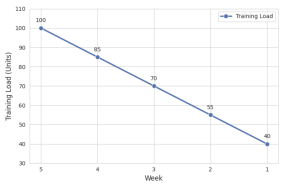
The Linear taper is as the name suggests a linear reduction in training each week
The Long Taper
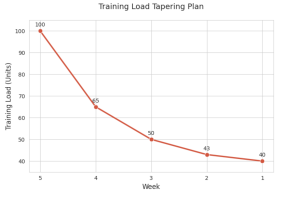
The Long Taper involves a rapid initial reduction in training load
The Drop off a Cliff Taper
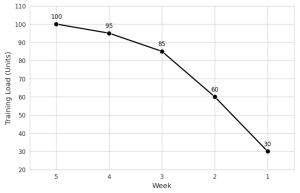
The Drop off a Cliff Taper involves a rapid late reduction in training load
Whilst the linear taper is the most common the other two are useful in some situations.
Eg if the athlete is feeling on the edge of overload , very fatigued , mentally tired etc then the long taper would suit better .
If the athlete is feeling fresh then the Drop off the cliff taper may work better.
Keep in mind the numbers for both are examples only and not exact prescriptions for training load reduction. You can also apply the same principles to a 21 day taper or a 14 day taper.
The length of the taper.
Whilst research leans heavily to a 21 day taper as optimal, keep in mind the research is based on marathon and shorter distances not ultras.
I think it’s a good starting point but other factors need to be considered, including
Fatigue levels of the athlete ( mental and physical )
Length of the peak training phase
Volume of training
Recovery capacity of the athlete
If the race is an A, B or C race
Significant travel time to get to the race
Significant changes in elevation or temperature from training to the race
Major time change from home to race location
Injury / niggle status
Lets discuss in detail
Fatigue levels.
Higher fatigue levels, mental or physical mean more taper is needed.
Don’t equate higher fatigue to higher volume, though – you can have an athlete doing 150km a week without much fatigue and another athlete doing 80km a week feeling very fatigued. It all depends on what their training history is. One runner may be used to running 100+ km a week, the other may have been sitting at 40 a week and increased to 80km a week in the last training block.
Fatigue is multifaceted, so it’s important to have a good understanding of how the athlete is performing physically and also how they are feeling mentally.
Some questions to ask yourself and your athlete to determine fatigue status
Can they still hit session targets in the higher intensity sessions?
Are they mentioning sore muscles or tired legs more than usual?
Are they still ticking off all their training sessions or are they missing some or cutting some short?
Is their sleep affected ? ( eg harder to get to sleep despite being really tired )
Do they find themselves more irritable than usual ?
Is there HRV status lower than usual or their resting HR higher than usual ?
The answers to these go a long way to determining if they need a longer or shorter taper.
Length of Peak Training phase.
The longer they are in the peak training phase, the greater chance they need a long taper. If peak training was only 4 weeks, then a 2-3 week taper is probably plenty, if they put in an 8+ week peak training block then 3-4 weeks is likely needed.
Volume of Training.
Long-term high-volume athletes tend to need less of a taper, whereas shorter-term high-volume athletes need more. By this I mean if an athlete has been running high volume consistently for months on end then they are likely well adapted to that and dont need a long taper whereas an athlete that has built from say 70-80km a week to 140+ may need a long taper.
Recovery Capacity.
After you have coached an athlete for a while, you get a sense of how well their body recovers from training. Some athletes you can throw anything at them and they never seem to really fatigue so only need a short taper , others, even the slightest increase in training, and there are signs that the athlete is at their limits, so a longer taper is required.
There are many reasons for this, which we talk about in the recovery video.
Changes from home to race location.
If the race location involves significant travel, is significantly different weather wise or is in a very different time zone to where the athlete lives, then this adds an extra level of stress that has to be factored into the taper.
You can’t just apply the normal taper and expect the athlete to deal with a 24 flight , a 10-hour time zone change, going from winter to summer and sea level to 1500m without impacting training. Those are all stresses on the body which need to be considered
Keep in mind the opposite can also occur, ie people racing in their hometown can be working until the night before the race. This also adds stress on the athlete ( travelling to a race usually means you finish work early, so can switch off from work stresses ). You may need to make that final week even easier to allow more time to sleep and rest, given they still have to work.
Injury / Niggle Status.
In the last 2-3 weeks, there is little to be gained fitness-wise from training; you are more maintaining and freshening up. We have to balance training load against increased rest to allow any niggles to settle. Any very minor loss of fitness is usually offset by the much greater loss in race time if the athlete suffers an injury or a flare-up of a niggle in a race. The taper is the time to err on the side of caution and let niggles settle.
Metrics.
Software such as training peaks ( and many others ) has three main metrics they use to reflect training stress, fitness and race readiness.
ATL, CTL and TSB – we talked about these in the metrics video but the one I want to mentioned again is TSB – training stress balance .
It measures the difference between your recent training load ( Acute Training Load ) and your longer-term training load (Chronic Training Load ) and reflects how fresh your legs are. If you are doing less training than usual, then your ATL is less than your CTL, so your TSB moves into the positives, indicating you are fresher than usual. Unfortunately, CTL is sometimes labelled fitness, and in a taper, your average long-term training load decreases, leading to lower “ fitness” scores. In reality, it has nothing to do with fitness,, just reduction in training load so educate your athletes to reassure them they are not losing fitness!
Now, there are some that say that when tapering for a race, you need to be at a certain TSB on race day. I would disagree with that as TSB is only a reflection of physical training load, it has zero to do with external stress, sleep, diet, mental state, etc, etc.
For trail runners, TSB ( and CTL and ATL ) are not as accurate because hiking and downhill usually have a lower training stress score than running even if effort feels the same. It’s good for week in week out comparisons if the training is fairly similar, but if you do less trails, more road or less vert, you may see training load go up, whereas in reality it feels like the same or less on the athlete. Dont use these metrics blindly, understand the data they are derived from.
Taper Problems.
Niggles.
The most common problem in a taper is the mysterious taper niggles; niggles that appear from no-where as training eases up. Instead of the athlete feeling fresh and confident the taper they feel stressed and worried about this mysterious niggle that hadn’t been felt until the taper started.
Most of the time the niggle vanishes as soon as the race starts and is due to heightened awareness that comes with a taper.
Sluggishness.
Runners often report feeling sluggish in a taper which is obviously goes against the idea of a taper freshening ones legs up. To combat this, keeping intensity in the taper is important – even if it’s just some strides in race week.
Catching a cold.
Coming down with a cold pre-race is the last thing an athlete wants.
This is another reason to keep some intensity in the taper, as despite common belief, the scientific evidence is leaning towards the idea that exercise, even intense exercise, boosts the immune system system not suppresses it.
If your athlete is travelling to a race, they are more likely to be exposed to a virus, so being vigilant with hand washing and basic hygiene is important.
Weight Gain.
For those athletes who regularly weigh themselves, they may notice a weight gain of a kilo or two. This is normal and is due to increased glycogen storage and the water molecules that bind with glycogen when stored in the muscle.
Talking through the above with your athlete prior to the taper ( especially the inexperienced ones ) can help alleviate the mental stress associated with them.
Nutrition in the taper we will cover in the Nutrition video.
The Psychology of a taper.
With reduced training comes more time to think. This can be used productively ( visualisation , relaxation , meditation , planning ) or negatively ( stress, anxiety , fear, overplaying ).
Talk with your athlete about how to deal with pre race nerves and use time productively.
We have discussed goal setting in the Sports Physiology videos.